

By Elena Petrova · Research Writer
Published · Updated
Answer in brief
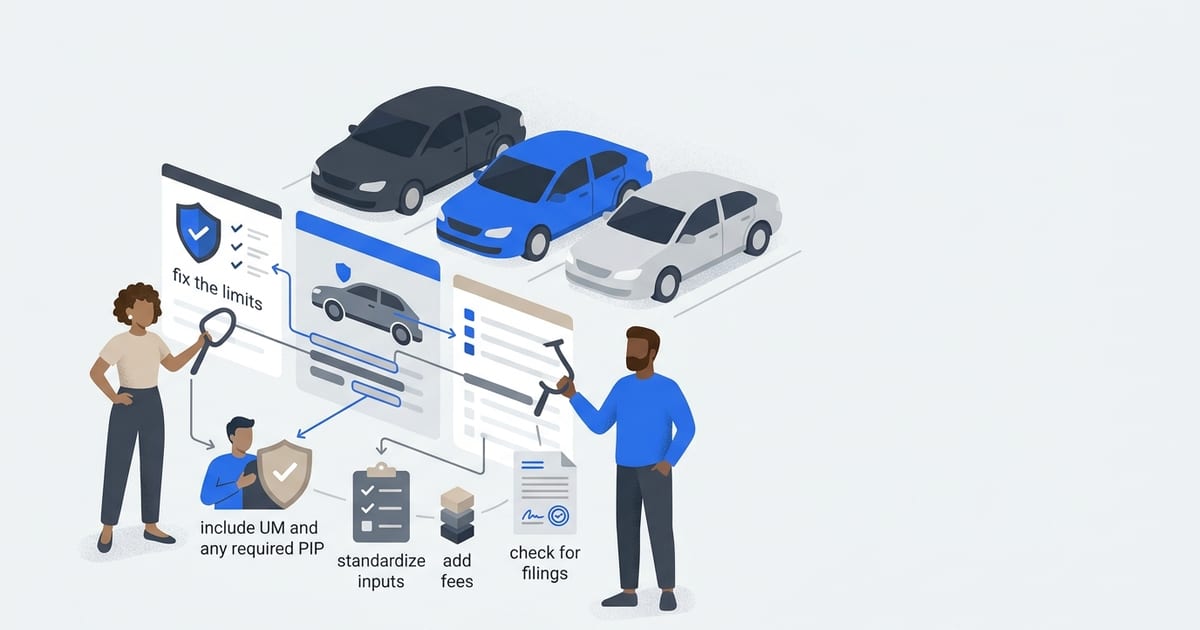
Liability-only quotes are simple to compare if you fix the limits first—for example 100/300/100 with matching UM—and keep the drivers, vehicles, address and mileage identical. Because liability pricing depends heavily on record, age, ZIP code and credit, and insurers weight those differently, the spread for the same driver is routinely 20–40%. Gather at least three quotes, add fees, confirm any required PIP or MedPay is included, and check that the insurer files SR-22s if you need one.
- 1
Fix the limits
Pick from the limits guide—100/300/100 plus matching UM is the usual baseline—and use the same figures in every quote.
- 2
Include what your state requires
PIP, MedPay or UM where mandatory; see state minimums.
- 3
Standardise inputs
Same drivers and licence dates, same vehicles, same garaging address, same accurate annual mileage.
- 4
Get three to five quotes
A comparison tool plus one or two direct, the same day.
- 5
Add fees and annualise
Installment, policy and filing fees; six- vs twelve-month terms.
- 6
Check filings and service
SR-22 capability if needed; complaint ratios from your state regulator.
- 7
Switch without a gap
New policy starts the day the old one ends.
Common mistakes
- Comparing a minimum-limits quote against a 100/300/100 quote and thinking one insurer is cheaper.
- Omitting UM from one quote and not the other.
- Understating mileage or using a different address to get a lower number.
- Ignoring installment fees that add $60–$120 a year.
Quote finder
Find auto insurance quotes that fit your situation
Questions & answers
Who has the cheapest liability-only insurance?
It varies by driver, state and year—there is no single answer. Compare several insurers for your exact limits.
Do I need to compare if I only want the minimum?
Yes. Minimum-coverage prices vary just as widely between insurers.
Does liability-only insurance require a down payment?
Most policies require the first installment at binding; terms vary by insurer.
Terms used in this guide
- Liability limits
- The maximum your policy pays for liability claims, written as three numbers in thousands (e.g. 100/300/100).
- Uninsured/underinsured motorist (UM/UIM)
- Pays for your injuries (and in some states vehicle damage) when the at-fault driver has no or too little insurance. Required in about twenty states.
- Premium
- The price of a policy, quoted per six or twelve months.
Sources and references
Legal figures on this page (minimum limits, filing periods, statutory benefits) are checked against the primary law or the state insurance regulator listed below. Links and figures last verified Nov 2026.
- Automobile financial responsibility limits by state — Insurance Information Institute (2023)Statistical dataCompulsory coverages and minimum liability limits by state (table dated December 2023 — several states have raised limits since; see statute entries).
- Nine ways to lower your auto insurance costs — Insurance Information InstituteConsumer guidanceShop at least three quotes; raising a deductible from $200 to $500 can cut collision/comprehensive cost 15–30%, $1,000 can save 40%+; drop physical damage on cars worth under 10× the premium; bundling, low-mileage and good-student discounts.
- How much auto coverage do I need? — Insurance Information InstituteConsumer guidanceWhy state minimums are a floor; choosing liability limits that protect assets; when collision and comprehensive are worth keeping.
- Consumer insurance information — National Association of Insurance CommissionersConsumer guidancePlain-language guides from the body of state insurance regulators; links to every state's insurance department and complaint process.
- Insurance research and advocacy — Consumer Federation of AmericaConsumer guidanceConsumer-side research on auto insurance pricing, non-driving rating factors and affordability.
- What is covered by a basic auto insurance policy? — Insurance Information InstituteConsumer guidanceDefines bodily injury and property damage liability, MedPay, PIP, uninsured/underinsured motorist, collision, comprehensive and glass coverage.
- Is it legal to drive without insurance? — Insurance Information InstituteConsumer guidanceEvery state requires drivers to demonstrate financial responsibility; in most states insurance is the mandatory way to do so.
- Car insurance — Consumer ReportsConsumer guidanceIndependent testing organisation's guides to comparing policies and insurers.
Practical guidance on this page is original editorial work. Cited sources support factual statements and do not endorse this site. Dollar ranges described as typical or illustrative are editorial estimates, not figures from these sources.
Guide
What Liability Limits to Choose
How to pick bodily injury and property damage limits: the state minimum vs 50/100/50 vs 100/300/100, what each protects, what each costs, and when an umbrella policy makes sense.
Guide
How Much Liability-Only Car Insurance Costs
Typical liability-only premiums by state and driver, how much cheaper it is than full coverage, and why the saving is smaller than people expect at higher limits.
Guide
Liability Insurance Minimums by State
Every state's minimum liability requirements and the extra coverages some states mandate—PIP, uninsured motorist, MedPay—in one reference table.