

By Marcus Bell · Editor
Published · Updated
Answer in brief
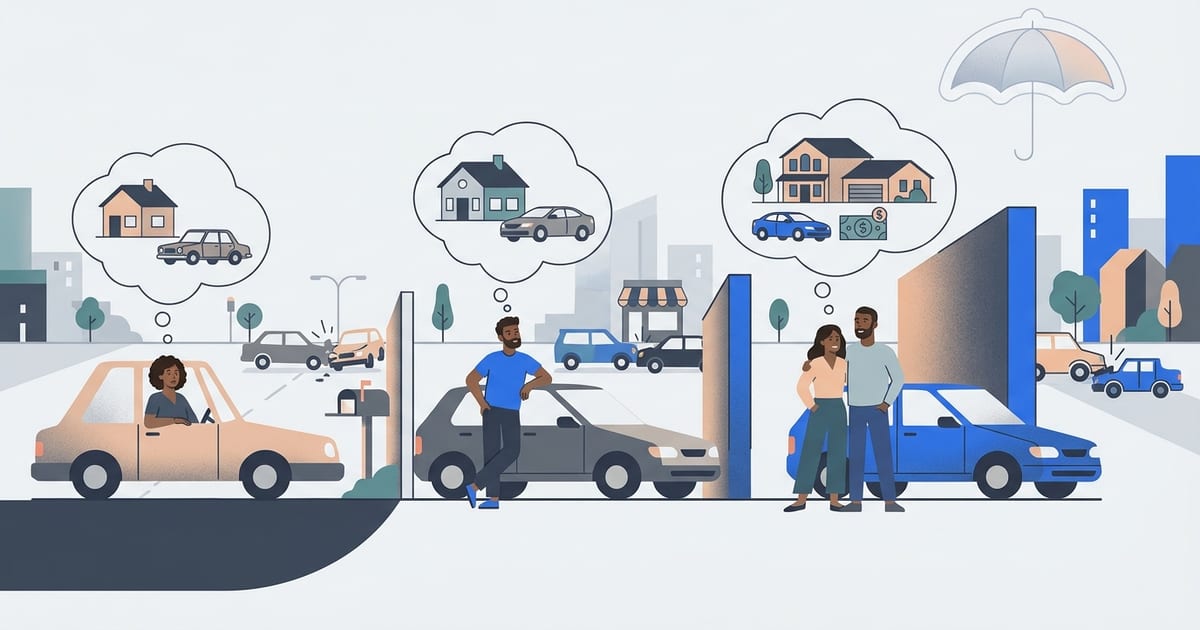
Choose liability limits by what you need to protect, not by the legal minimum. 100/300/100 is the widely recommended baseline for anyone with a job, savings or a home; it typically costs only 15–30% more than the minimum. 50/100/50 is a reasonable middle for tight budgets. 250/500/100 plus an umbrella policy suits households with significant assets. Property damage of at least $50,000–$100,000 reflects what modern vehicles cost to replace. Whatever you choose, match uninsured motorist limits to your bodily injury limits.
The common choices
| Limits | Who it suits | Typical extra cost vs minimum |
|---|---|---|
| State minimum (often 25/50/25) | Almost no one; legal floor only | — |
| 50/100/50 | Tight budget, few assets | +8–15% |
| 100/300/100 | Recommended baseline for most households | +15–30% |
| 250/500/100 | Homeowners, higher incomes | +30–45% |
| 250/500/100 + $1M umbrella | Significant assets | Umbrella adds ~$150–$400/year |
Why 100/300/100 is the usual recommendation
It covers the large majority of serious crashes without exhausting, it is priced attractively because most of the premium is in the first layer, and it is the minimum underlying limit most umbrella policies require. Below it, an ordinary serious injury—one surgery and a few months off work—can exceed the limit and reach your savings and wages.
Property damage
The average new vehicle costs well over $40,000, and a crash can involve more than one. $25,000 property damage is exhausted by a single late-model car. $50,000 is the practical minimum; $100,000 is sensible.
Quote finder
Find auto insurance quotes that fit your situation
Uninsured motorist
Carry UM/UIM at the same limits as your bodily injury coverage. It protects you from the other driver's bad decision, costs relatively little, and is required in about twenty states anyway.
Entries in this guide
Specific questions answered in more depth.
Questions & answers
Is 100/300/100 enough?
For most households, yes. Those with significant assets should add an umbrella policy.
What does the third number mean?
Property damage liability per accident, in thousands. 100/300/100 means $100,000 for property damage.
What is a combined single limit?
One limit for all injuries and property damage in a crash (for example $300,000 CSL), instead of separate per-person, per-accident and property figures.
Terms used in this guide
- Liability limits
- The maximum your policy pays for liability claims, written as three numbers in thousands (e.g. 100/300/100).
- Split limits
- Separate limits for BI per person, BI per accident and PD per accident—the common 25/50/25 format.
- Combined single limit (CSL)
- One limit covering all injuries and property damage in a single crash, instead of split limits.
- Umbrella policy
- Extra liability coverage—usually $1 million or more—that sits above your auto and home limits. Requires underlying limits of about 250/500.
Sources and references
Legal figures on this page (minimum limits, filing periods, statutory benefits) are checked against the primary law or the state insurance regulator listed below. Links and figures last verified Nov 2026.
- 14 percent of U.S. drivers were uninsured in 2022 — Insurance Research Council (2023)Independent researchAbout one in seven drivers was uninsured in 2022; highest D.C. 25.2%, New Mexico 24.9%, Mississippi 22.2%; lowest Wyoming 5.9%, Maine 6.2%, Idaho 6.2%. Method: ratio of UM to BI claim frequencies.
- Automobile financial responsibility limits by state — Insurance Information Institute (2023)Statistical dataCompulsory coverages and minimum liability limits by state (table dated December 2023 — several states have raised limits since; see statute entries).
- Estimated percentage of uninsured motorists by state, 2017–2023 — Insurance Information Institute (2025)Statistical dataIRC time series by state; 2023: Mississippi 28.2%, New Mexico 24.1%, D.C. 23.1%, Michigan 22.3%, Florida 20.6%, California 20.4%, Texas 14.5%; lowest Maine 5.7%.
- Facts + Statistics: Uninsured motorists — Insurance Information Institute (2024)Statistical dataInsurance Research Council estimates of uninsured drivers by state (2022: e.g. Michigan 19.6%, California 17.0%, Florida 15.9%, Texas 13.8%).
- How much auto coverage do I need? — Insurance Information InstituteConsumer guidanceWhy state minimums are a floor; choosing liability limits that protect assets; when collision and comprehensive are worth keeping.
- What is covered by a basic auto insurance policy? — Insurance Information InstituteConsumer guidanceDefines bodily injury and property damage liability, MedPay, PIP, uninsured/underinsured motorist, collision, comprehensive and glass coverage.
- Insurance research and advocacy — Consumer Federation of AmericaConsumer guidanceConsumer-side research on auto insurance pricing, non-driving rating factors and affordability.
- Is it legal to drive without insurance? — Insurance Information InstituteConsumer guidanceEvery state requires drivers to demonstrate financial responsibility; in most states insurance is the mandatory way to do so.
Practical guidance on this page is original editorial work. Cited sources support factual statements and do not endorse this site. Dollar ranges described as typical or illustrative are editorial estimates, not figures from these sources.
Guide
What Liability-Only Car Insurance Covers
Exactly what a liability-only policy pays for—bodily injury and property damage to others—and the list of things it never covers, including your own car.
Guide
Liability Insurance Minimums by State
Every state's minimum liability requirements and the extra coverages some states mandate—PIP, uninsured motorist, MedPay—in one reference table.
Guide
How Much Liability-Only Car Insurance Costs
Typical liability-only premiums by state and driver, how much cheaper it is than full coverage, and why the saving is smaller than people expect at higher limits.