

By Elena Petrova · Research Writer
Published · Updated
Answer in brief
Every state except New Hampshire requires liability insurance (and New Hampshire requires proof of financial responsibility after an incident). Minimums range from $10,000 property damage and PIP only in Florida to 50/100/25 in Alaska and Maine and 50/100/50 in Michigan; the most common minimum is 25/50/25. About twenty states also require uninsured motorist coverage and a dozen require PIP. The minimum is a legal floor, not a recommendation—most advisers suggest at least 100/300/100.
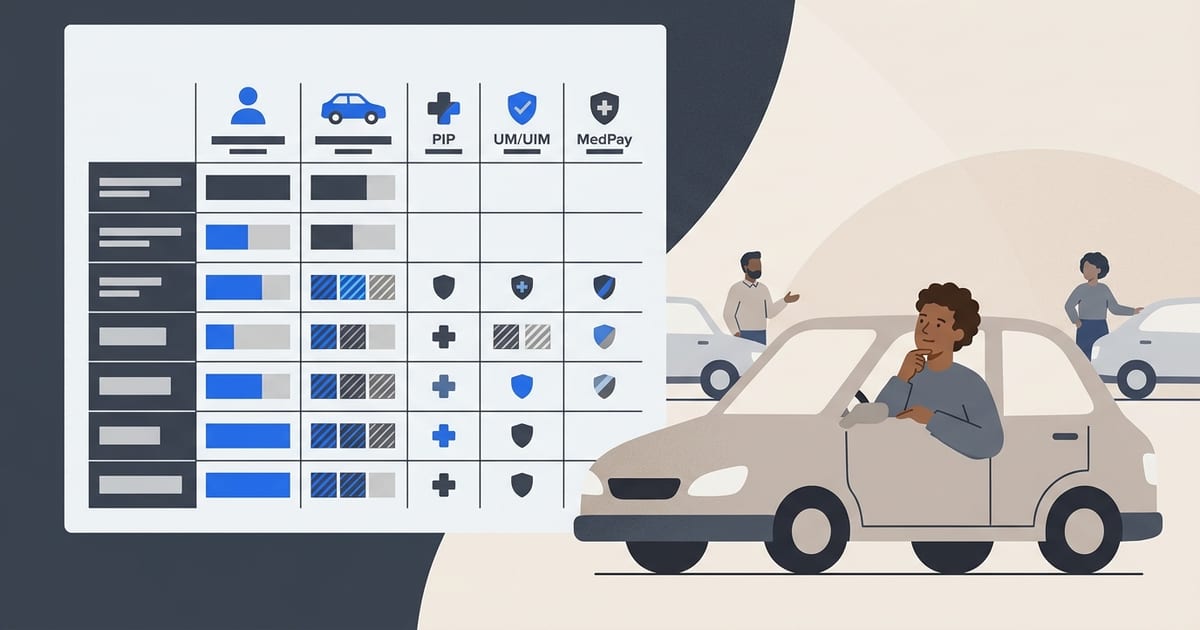
Reading the numbers
Minimums are written as three numbers in thousands: bodily injury per person / bodily injury per accident / property damage per accident. 25/50/25 means $25,000 per injured person, $50,000 total for injuries in one crash, and $25,000 for property damage.
Minimums by state
| State | Liability minimum | Also required |
|---|---|---|
| Alabama | 25/50/25 | — |
| Alaska | 50/100/25 | — |
| Arizona | 25/50/15 | — |
| Arkansas | 25/50/25 | — |
| California | 30/60/15 (from Jan 2025; 50/100/25 from 2035) | — |
| Colorado | 25/50/15 | — |
| Connecticut | 25/50/25 | UM/UIM |
| Delaware | 25/50/10 | PIP |
| Florida | PD $10k (no BI for most drivers) | PIP $10k |
| Georgia | 25/50/25 | — |
| Hawaii | 40/80/20 (from Jan 2026) | PIP $10k; UM/UIM unless rejected |
| Idaho | 25/50/15 | — |
| Illinois | 25/50/20 | UM |
| Indiana | 25/50/25 | — |
| Iowa | 20/40/15 | — |
| Kansas | 25/50/25 | PIP, UM/UIM |
| Kentucky | 25/50/25 | PIP |
| Louisiana | 15/30/25 | — |
| Maine | 50/100/25 | UM/UIM, MedPay |
| Maryland | 30/60/15 | UM/UIM, PIP (waivable) |
| Massachusetts | 25/50/30 (from Jul 2025) | PIP $8k, UM |
| Michigan | 50/100/10 | PIP (choice), PPI |
| Minnesota | 30/60/10 | PIP, UM/UIM |
| Mississippi | 25/50/25 | — |
| Missouri | 25/50/25 | UM |
| Montana | 25/50/20 | — |
| Nebraska | 25/50/25 | UM/UIM |
| Nevada | 25/50/20 | — |
| New Hampshire | 25/50/25 (if purchased) | UM, MedPay |
| New Jersey | 35/70/25 standard (from Jan 2026) | PIP $15k, UM/UIM |
| New Mexico | 25/50/10 | — |
| New York | 25/50/10 | PIP, UM |
| North Carolina | 50/100/50 (from Jul 2025) | UM/UIM |
| North Dakota | 25/50/25 | PIP, UM/UIM |
| Ohio | 25/50/25 | — |
| Oklahoma | 25/50/25 | — |
| Oregon | 25/50/20 | PIP, UM/UIM |
| Pennsylvania | 15/30/5 | Medical benefits |
| Rhode Island | 25/50/25 | — |
| South Carolina | 25/50/25 | UM |
| South Dakota | 25/50/25 | UM/UIM |
| Tennessee | 25/50/25 | — |
| Texas | 30/60/25 | — |
| Utah | 30/65/25 (from Jan 2025) | PIP |
| Vermont | 25/50/10 | UM/UIM |
| Virginia | 50/100/25 (from Jan 2025) | UM/UIM |
| Washington | 25/50/10 | — |
| West Virginia | 25/50/25 | UM |
| Wisconsin | 25/50/10 | UM |
| Wyoming | 25/50/20 | — |
Why minimums are too low
A single hospital admission after a crash can exceed $50,000; a new mid-size car costs more than $25,000 to replace. Minimum limits are exhausted by ordinary serious crashes, and you are personally liable for the remainder. The limits guide explains how to pick a number.
Questions & answers
What is the most common state minimum?
25/50/25—$25,000 per person, $50,000 per accident for injuries, $25,000 property damage.
Which state has the lowest minimum?
Florida (no bodily injury requirement for most drivers—only $10,000 property damage and $10,000 PIP) and Pennsylvania (15/30/5) are the lowest. California left this group in 2025 when it moved from 15/30/5 to 30/60/15.
Do I need uninsured motorist coverage?
About twenty states require it. Everywhere else it is optional and strongly recommended.
Terms used in this guide
- State minimum
- The lowest liability limits (and any other coverages) a state requires to register and drive a vehicle. A legal floor, not a recommendation.
- Split limits
- Separate limits for BI per person, BI per accident and PD per accident—the common 25/50/25 format.
- Uninsured/underinsured motorist (UM/UIM)
- Pays for your injuries (and in some states vehicle damage) when the at-fault driver has no or too little insurance. Required in about twenty states.
- Personal injury protection (PIP)
- No-fault coverage for your own injuries regardless of fault, required in about a dozen states.
Sources and references
Legal figures on this page (minimum limits, filing periods, statutory benefits) are checked against the primary law or the state insurance regulator listed below. Links and figures last verified Nov 2026.
- Vehicle Code § 16056 — minimum liability limits — California Legislative Information, Cal. Veh. Code § 16056Primary lawPolicies issued or renewed on/after 1 Jan 2025: $30,000 per person / $60,000 per accident bodily injury / $15,000 property damage. From 1 Jan 2035 the limits rise by $20,000 / $40,000 / $10,000 (to 50/100/25).
- Utah Code § 31A-22-304 — motor vehicle liability policy minimum limits — Utah Legislature, Utah Code § 31A-22-304Primary lawPolicies issued or renewed on/after 1 Jan 2025: $30,000 per person / $65,000 per accident / $25,000 property damage (or $90,000 single limit).
- Va. Code § 46.2-472 — minimum liability limits — Virginia Law (LIS), Va. Code § 46.2-472Primary lawFor policies effective on/after 1 Jan 2025: $50,000 per person / $100,000 per accident bodily injury / $25,000 property damage.
- Acts of 2024, Chapter 275 — An Act relative to motor vehicle insurance — Massachusetts General Court, Mass. Acts 2024, c. 275 (2024)Primary lawRaises compulsory bodily injury limits to $25,000 / $50,000 and property damage to $30,000 for policies issued or renewed on/after 1 July 2025.
- HRS § 431:10C-301 — required motor vehicle policy coverage — Hawaii State Legislature, HRS § 431:10C-301Primary lawLiability of at least $40,000 per person / $80,000 per accident and $20,000 property damage (effective 1 Jan 2026 under Act 138 of 2024); PIP $10,000; UM/UIM offered with written rejection.
- Fla. Stat. § 324.022 — property damage liability requirement — Florida Legislature (Online Sunshine), Fla. Stat. § 324.022Primary lawEvery owner must maintain at least $10,000 property damage liability (or a $30,000 combined single limit with PIP).
- K.S.A. 40-3107 — required motor vehicle liability policy contents — Kansas Office of Revisor of Statutes, K.S.A. 40-3107Primary lawMinimum 25/50/25 liability plus mandatory PIP and uninsured/underinsured motorist coverage.
- Changes to the rating of automobile insurance policies, effective July 1, 2025 — North Carolina Department of Insurance (2025)State insurance regulatorMinimum limits rose from 30/60/25 to 50/100/50 for policies issued or renewed on/after 1 July 2025; underinsured motorist coverage now included on all policies.
- Bulletin 25-06 — auto insurance coverage limits (P.L. 2022, c. 87) — New Jersey Department of Banking and Insurance (2025)State insurance regulatorSecond-phase increase to $35,000 per person / $70,000 per accident for policies issued or renewed on/after 1 Jan 2026; property damage stays $25,000.
- Background on: No-fault auto insurance — Insurance Information InstituteIndependent researchWhich states use personal injury protection (PIP), how no-fault thresholds work, and reform history including Michigan and Florida.
- Automobile financial responsibility limits by state — Insurance Information Institute (2023)Statistical dataCompulsory coverages and minimum liability limits by state (table dated December 2023 — several states have raised limits since; see statute entries).
Practical guidance on this page is original editorial work. Cited sources support factual statements and do not endorse this site. Dollar ranges described as typical or illustrative are editorial estimates, not figures from these sources.
Guide
What Liability-Only Car Insurance Covers
Exactly what a liability-only policy pays for—bodily injury and property damage to others—and the list of things it never covers, including your own car.
Guide
What Liability Limits to Choose
How to pick bodily injury and property damage limits: the state minimum vs 50/100/50 vs 100/300/100, what each protects, what each costs, and when an umbrella policy makes sense.
Guide
How Much Liability-Only Car Insurance Costs
Typical liability-only premiums by state and driver, how much cheaper it is than full coverage, and why the saving is smaller than people expect at higher limits.