

By Marcus Bell · Editor
Published · Updated
Answer in brief
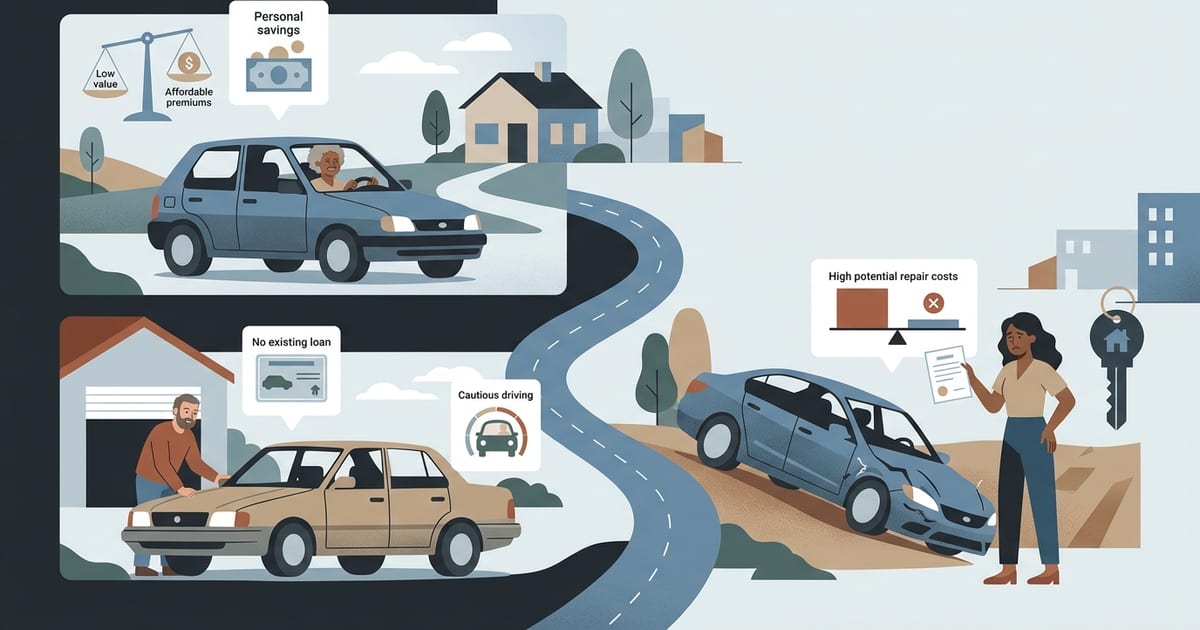
Liability-only makes sense when the car is owned outright, its value is low enough that you could replace it from savings, and the annual cost of collision and comprehensive is a large share of that value—a common rule of thumb is 10% or more. It is a mistake when the car is financed or leased (lenders require full coverage), when you could not afford to replace it, when you live in a high-theft or severe-weather area and the car is worth more than a few thousand dollars, or when you drop liability limits rather than collision and comprehensive to save money.
The test
- 1
Is the car financed or leased?
If yes, full coverage is required. Stop here.
- 2
What is the car worth?
Look up its actual cash value—the amount an insurer would pay if it were totalled.
- 3
What do collision and comprehensive cost per year?
Find the lines on your declarations page.
- 4
Compare
If those two coverages cost 10% or more of the car's value each year, or the value minus deductible is small, liability-only is usually reasonable.
- 5
Could you replace the car tomorrow?
If losing the car would leave you without transport and without the money to replace it, keep collision a while longer or raise the deductible instead.
Situations where liability-only fits
- A paid-off car worth under about $5,000.
- A second or third household vehicle used occasionally.
- A reliable older car you plan to run until it stops, with savings to replace it.
- A driver whose premium is high for reasons unrelated to the car (young, urban, recent ticket), where collision would cost more than the car is worth within two years.
Situations where it is a mistake
- Dropping liability limits to the minimum to save money—see limits to choose.
- A car worth $10,000+ in a hail belt, hurricane coast or high-theft area—consider keeping comprehensive alone.
- Any financed or leased vehicle.
- A household with one car and no savings to replace it.
Entries in this guide
Specific questions answered in more depth.
Entry
Comprehensive-Only Coverage: The Middle Option
Why keeping comprehensive while dropping collision is often the best choice for a mid-value car, what it costs, and when it applies.
Entry
Liability-Only Car Insurance for Teen Drivers: When Does It Make Sense?
Evaluate liability-only insurance for teen drivers. Learn how crash risk affects liability limits, asset exposure, and vehicle choices for families.
Questions & answers
At what car value should I go liability-only?
When collision and comprehensive cost 10% or more of the car's value per year, typically around $4,000–$6,000 for most drivers.
Can I have liability-only on a financed car?
No. Lenders require collision and comprehensive until the loan is paid.
Is liability-only enough for an old car?
Often yes for the car itself—but carry adequate liability limits and uninsured motorist coverage regardless of the car's value.
Terms used in this guide
- Actual cash value (ACV)
- What your car was worth just before a loss—replacement cost minus depreciation. The basis for deciding whether collision is worth keeping.
- Collision coverage
- Pays to repair or replace your own car after a crash, minus the deductible. Not included in a liability-only policy.
- Comprehensive coverage
- Pays for non-crash damage to your car—theft, weather, flood, fire, vandalism, animals, glass. Can be carried without collision.
- Deductible
- What you pay before collision or comprehensive pays. Liability coverages have no deductible.
Sources and references
Legal figures on this page (minimum limits, filing periods, statutory benefits) are checked against the primary law or the state insurance regulator listed below. Links and figures last verified Nov 2026.
- Automobile financial responsibility limits by state — Insurance Information Institute (2023)Statistical dataCompulsory coverages and minimum liability limits by state (table dated December 2023 — several states have raised limits since; see statute entries).
- Insurance losses by make and model — Highway Loss Data InstituteStatistical dataRelative claim frequency and severity by vehicle under collision, property damage, comprehensive, PIP, MedPay and bodily injury coverages.
- How much auto coverage do I need? — Insurance Information InstituteConsumer guidanceWhy state minimums are a floor; choosing liability limits that protect assets; when collision and comprehensive are worth keeping.
- Nine ways to lower your auto insurance costs — Insurance Information InstituteConsumer guidanceShop at least three quotes; raising a deductible from $200 to $500 can cut collision/comprehensive cost 15–30%, $1,000 can save 40%+; drop physical damage on cars worth under 10× the premium; bundling, low-mileage and good-student discounts.
- What is covered by a basic auto insurance policy? — Insurance Information InstituteConsumer guidanceDefines bodily injury and property damage liability, MedPay, PIP, uninsured/underinsured motorist, collision, comprehensive and glass coverage.
- Is it legal to drive without insurance? — Insurance Information InstituteConsumer guidanceEvery state requires drivers to demonstrate financial responsibility; in most states insurance is the mandatory way to do so.
- Understanding your insurance deductibles — Insurance Information InstituteConsumer guidanceHow deductibles apply to collision and comprehensive and how raising them lowers premium.
- What is gap insurance? — Insurance Information InstituteConsumer guidanceGap coverage pays the difference between a car's actual cash value and the loan or lease balance after a total loss.
Practical guidance on this page is original editorial work. Cited sources support factual statements and do not endorse this site. Dollar ranges described as typical or illustrative are editorial estimates, not figures from these sources.
Guide
When to Drop Full Coverage and Go Liability-Only
The signals that it is time to drop collision and comprehensive: car value, premium share, deductible, savings, loan payoff, and how to make the change without a gap.
Guide
Liability-Only vs Full Coverage
A direct comparison of liability-only and full coverage: what each pays, what each costs, and a worked example for cars of different values.
Guide
What Liability Limits to Choose
How to pick bodily injury and property damage limits: the state minimum vs 50/100/50 vs 100/300/100, what each protects, what each costs, and when an umbrella policy makes sense.