

By Marcus Bell · Editor
Published · Updated
Answer in brief
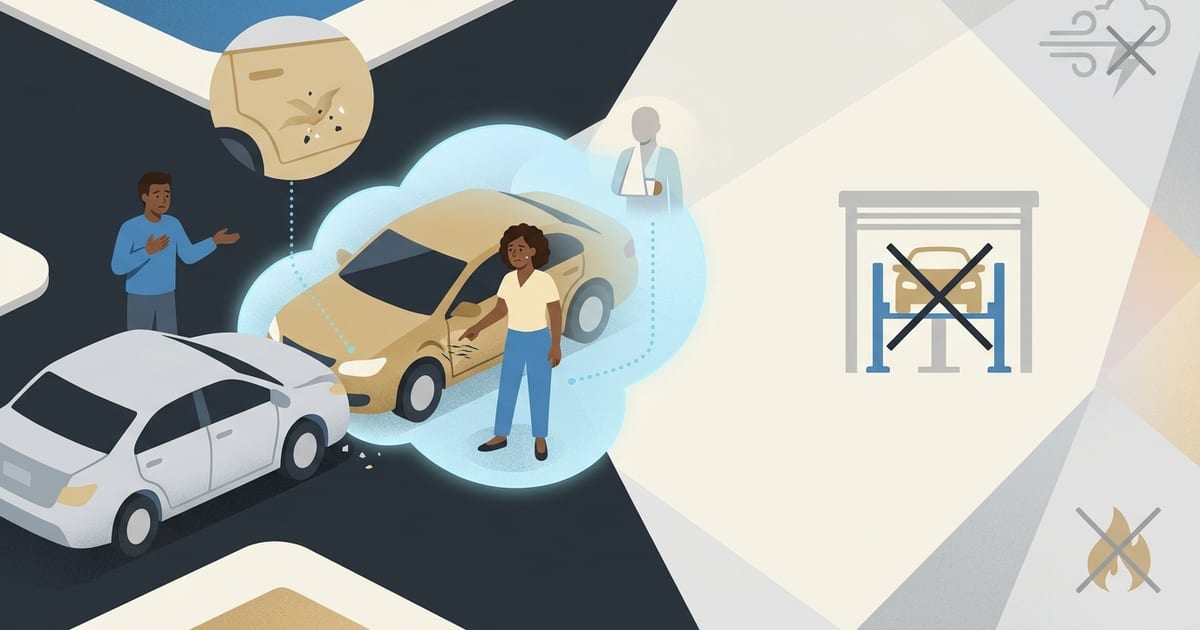
A liability-only policy pays for injuries and property damage you cause to other people—their medical bills, lost wages, pain and suffering, vehicle repairs and other property—up to your limits, plus your legal defence if you are sued. It pays nothing for your own car, your own injuries (unless your state requires PIP or MedPay), theft, weather or vandalism. It is the legal minimum structure in every state and the right choice for a car whose value no longer justifies collision and comprehensive premiums.
The two liability coverages
| Coverage | Pays for | Example |
|---|---|---|
| Bodily injury liability (BI) | Injuries you cause to others: medical, lost income, pain and suffering, funeral costs | You rear-end a car; the driver's ER visit and physical therapy |
| Property damage liability (PD) | Damage you cause to others' property | Their car's repair, a fence, a storefront |
Both also pay for your legal defence if the injured party sues, usually in addition to the limits. That defence obligation is one of the most valuable and least appreciated parts of a liability policy.
What it does not cover
- Damage to your own car from any cause—crash, theft, hail, flood, vandalism, animal strike.
- Your own injuries, unless your state requires or you add PIP or medical payments coverage.
- Your passengers' injuries in a crash you cause—those fall under BI only if the passengers are not household members, and some policies exclude them.
- A rental car while yours is repaired.
- Roadside assistance or towing.
- Injuries caused to you by an uninsured driver—that is uninsured motorist coverage, which many states require alongside liability.
What a 'liability-only' policy often includes anyway
In practice a minimum policy includes whatever the state mandates: PIP in no-fault states, uninsured motorist in about twenty states, MedPay in a few. So "liability-only" usually means "everything required, nothing for my own car". The state minimums guide lists what each state adds.
Entries in this guide
Specific questions answered in more depth.
Questions & answers
Does liability insurance cover my car if I'm not at fault?
Not yours—the at-fault driver's property damage liability pays for your car. If they are uninsured, your own collision or UM property damage coverage would be needed.
Does liability cover my passengers?
Bodily injury liability typically covers non-household passengers injured in a crash you cause. Household members are often excluded.
Does liability insurance cover theft?
No. Theft is covered by comprehensive.
Terms used in this guide
- Bodily injury liability (BI)
- Pays for injuries you cause to others—medical costs, lost income, pain and suffering—and your legal defence, up to the per-person and per-accident limits.
- Property damage liability (PD)
- Pays for damage you cause to other people's property—vehicles, buildings, fences—up to the per-accident limit.
- Liability limits
- The maximum your policy pays for liability claims, written as three numbers in thousands (e.g. 100/300/100).
- Split limits
- Separate limits for BI per person, BI per accident and PD per accident—the common 25/50/25 format.
Sources and references
Legal figures on this page (minimum limits, filing periods, statutory benefits) are checked against the primary law or the state insurance regulator listed below. Links and figures last verified Nov 2026.
- Automobile financial responsibility limits by state — Insurance Information Institute (2023)Statistical dataCompulsory coverages and minimum liability limits by state (table dated December 2023 — several states have raised limits since; see statute entries).
- What is covered by a basic auto insurance policy? — Insurance Information InstituteConsumer guidanceDefines bodily injury and property damage liability, MedPay, PIP, uninsured/underinsured motorist, collision, comprehensive and glass coverage.
- How much auto coverage do I need? — Insurance Information InstituteConsumer guidanceWhy state minimums are a floor; choosing liability limits that protect assets; when collision and comprehensive are worth keeping.
- Consumer insurance information — National Association of Insurance CommissionersConsumer guidancePlain-language guides from the body of state insurance regulators; links to every state's insurance department and complaint process.
- Is it legal to drive without insurance? — Insurance Information InstituteConsumer guidanceEvery state requires drivers to demonstrate financial responsibility; in most states insurance is the mandatory way to do so.
Practical guidance on this page is original editorial work. Cited sources support factual statements and do not endorse this site. Dollar ranges described as typical or illustrative are editorial estimates, not figures from these sources.
Guide
What Liability Limits to Choose
How to pick bodily injury and property damage limits: the state minimum vs 50/100/50 vs 100/300/100, what each protects, what each costs, and when an umbrella policy makes sense.
Guide
Liability-Only vs Full Coverage
A direct comparison of liability-only and full coverage: what each pays, what each costs, and a worked example for cars of different values.
Guide
Liability Insurance Minimums by State
Every state's minimum liability requirements and the extra coverages some states mandate—PIP, uninsured motorist, MedPay—in one reference table.