

By Marcus Bell · Editor
Published · Updated
Answer in brief
Comprehensive without collision covers theft, weather, flood, fire, vandalism, animal strikes and glass for a fraction of the cost of full coverage—often $100–$250 a year. For a paid-off car worth $4,000–$10,000, it protects against the losses that happen to a parked car while leaving the (more expensive) crash risk to you.
What comprehensive covers
Everything that damages your car other than a collision with another vehicle or object: theft, hail, flood, falling trees, fire, vandalism, hitting an animal, and glass. These are the risks you cannot reduce by driving carefully, which is why comprehensive is the coverage to keep when you can only keep one.
Cost
Comprehensive is typically a quarter to a third of collision's cost for the same vehicle. On a $7,000 car it might be $150 a year with a $500 deductible, against $450 for collision.
When it fits
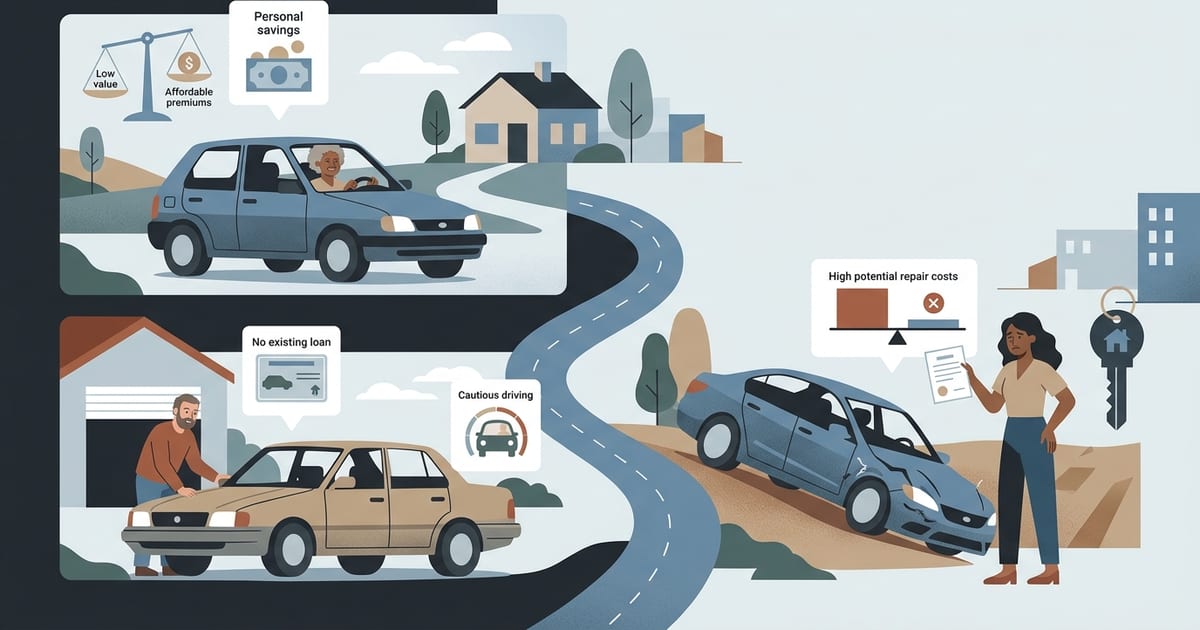
- Paid-off car worth $4,000–$10,000.
- Areas with hail, hurricanes, flooding or high theft.
- Rural areas with frequent animal strikes.
- A car stored for part of the year—some insurers allow comprehensive-only on a stored car.
The broader decision framework is in when liability-only makes sense.
Terms: Comprehensive coverage, Collision coverage, Actual cash value (ACV)
Sources and references
Legal figures on this page (minimum limits, filing periods, statutory benefits) are checked against the primary law or the state insurance regulator listed below. Links and figures last verified Nov 2026.
- Trends and Insights: Auto insurance rates (June 2024) — Insurance Information Institute (2024)Independent researchWhy premiums rose 2021–2024: crash frequency and severity, repair and labour inflation, vehicle technology, attorney involvement.
- Insurance losses by make and model — Highway Loss Data InstituteStatistical dataRelative claim frequency and severity by vehicle under collision, property damage, comprehensive, PIP, MedPay and bodily injury coverages.
- 2019–2023 Auto Insurance Database: average premium supplement — National Association of Insurance Commissioners (2025)Statistical dataCountrywide average expenditure $1,281 in 2023 (+13.98%); combined average premium $1,438; state tables for liability, collision and comprehensive.
- Facts + Statistics: Auto insurance — Insurance Information Institute (2025)Statistical dataNAIC countrywide average auto expenditure: $1,127 (2022), $1,282 (2023); most expensive states in 2023 were Florida, Louisiana and New York.
- What is covered by a basic auto insurance policy? — Insurance Information InstituteConsumer guidanceDefines bodily injury and property damage liability, MedPay, PIP, uninsured/underinsured motorist, collision, comprehensive and glass coverage.
- How much auto coverage do I need? — Insurance Information InstituteConsumer guidanceWhy state minimums are a floor; choosing liability limits that protect assets; when collision and comprehensive are worth keeping.
- Understanding your insurance deductibles — Insurance Information InstituteConsumer guidanceHow deductibles apply to collision and comprehensive and how raising them lowers premium.
- What is gap insurance? — Insurance Information InstituteConsumer guidanceGap coverage pays the difference between a car's actual cash value and the loan or lease balance after a total loss.
Practical guidance on this page is original editorial work. Cited sources support factual statements and do not endorse this site. Dollar ranges described as typical or illustrative are editorial estimates, not figures from these sources.
Entry
Liability-Only Car Insurance for Teen Drivers: When Does It Make Sense?
Evaluate liability-only insurance for teen drivers. Learn how crash risk affects liability limits, asset exposure, and vehicle choices for families.
Parent guide
When Liability-Only Car Insurance Makes Sense
A practical test for choosing liability-only: car value, savings, loan status and risk tolerance—and the situations where it is a mistake.