

By Marcus Bell · Editor
Published
Answer in brief
Adding a teen driver to an auto policy sharply increases premiums due to elevated crash frequencies. Switching an older, low-value vehicle assigned to a teenager to liability-only insurance can reduce ongoing costs, provided the liability limits are high enough to protect household assets from serious crash claims.
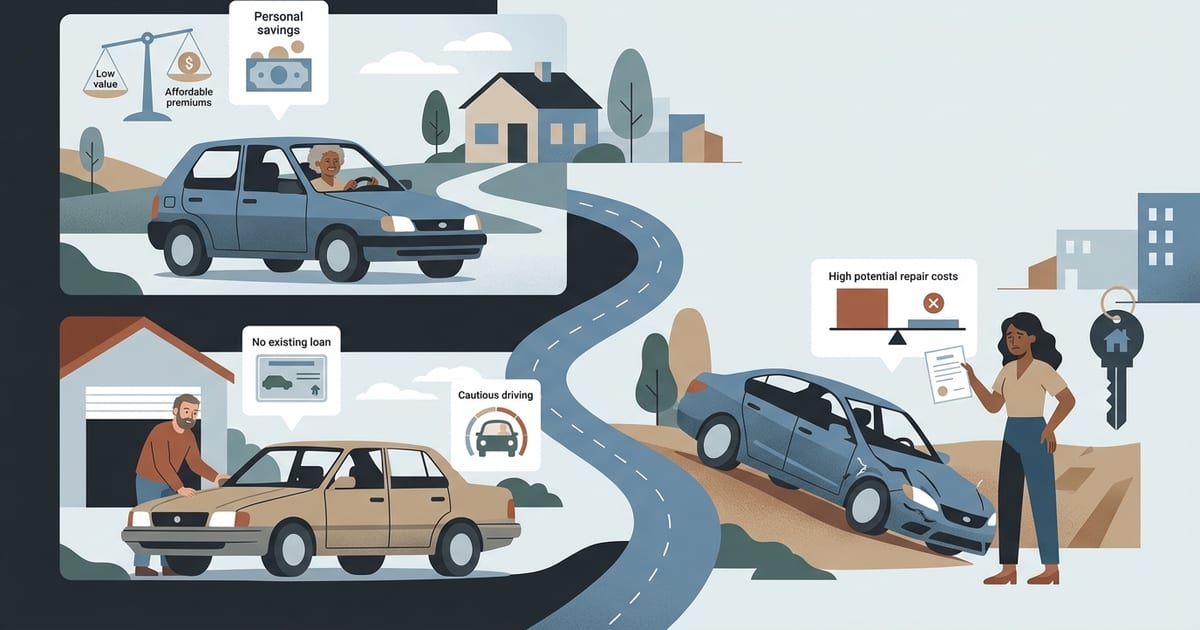
Insuring a newly licensed teenage driver represents one of the steepest premium increases a household can encounter. Because inexperienced drivers carry statistically higher crash frequencies, policyholders frequently evaluate whether carrying liability-only car insurance on a teenager's vehicle makes financial sense compared to maintaining full coverage.
The fundamental tension lies between physical damage protection and financial liability. While dropping collision and comprehensive eliminates repair payouts for the teen's vehicle, liability coverage remains compulsory to pay for injuries and property damage inflicted on others.
Why Teen Drivers Face Elevated Insurance Premiums
Insurance pricing directly reflects statistical underwriting risk. According to the Insurance Institute for Highway Safety, the fatal crash rate per mile driven for 16-to-19-year-olds is just over three times the rate for drivers aged 20 and older, while their all-severity crash rate is more than four times higher. The Insurance Information Institute notes that fatal-crash involvement per 100,000 licensed drivers reached 42.40 for ages 16–20 in 2023, compared to 24.18 for drivers aged 35–44.
Liability-Only vs Full Coverage on an Older Teen Car
Families often assign an older, depreciated vehicle to a high school or college driver. Under the 10 percent guideline described by industry guidelines, when the annual cost of comprehensive and collision coverage exceeds 10 percent of the car's actual cash value, carrying physical damage protection becomes economically inefficient.
For instance, if an older sedan is worth $4,000 and collision and comprehensive premiums add an illustrative $900 annually with a $1,000 deductible, the maximum net recovery after a total loss is only $3,000. In such scenarios, opting for liability-only coverage stops the drain of paying high physical damage premiums on a car that would yield minimal payout after a collision.
The Risk of State-Minimum Limits with Teen Drivers
Choosing liability-only insurance does not mean purchasing only the bare state minimum. In fact, pairing an inexperienced driver with minimum statutory limits presents substantial exposure to personal assets.
Several states mandate modest minimum limits. For example, California (Cal. Veh. Code § 16056) requires $30,000 per person and $60,000 per accident for bodily injury, along with $15,000 for property damage. Florida (Fla. Stat. § 324.022) requires only $10,000 in property damage liability alongside PIP. Given vehicle replacement costs and modern medical care expenses, an at-fault multi-vehicle crash caused by a novice driver can easily exceed these figures. Parents remain personally liable for unpaid damages beyond policy limits.
Checklist: Deciding on Liability-Only for a Young Driver
- 1
Verify Vehicle Ownership and Liens
Ensure the car has no outstanding loan or lease. Lenders mandate collision and comprehensive until the lien is satisfied.
- 2
Assess Vehicle Actual Cash Value
Estimate fair market value. If the car is worth less than several times the annual physical damage premium plus deductible, liability-only is a candidate.
- 3
Select Robust Liability Limits
Maintain higher liability thresholds rather than state minimums to ensure legal defense and asset protection during serious crash claims.
- 4
Verify Compulsory Endorsements
Confirm whether state law requires personal injury protection or uninsured motorist coverage, such as in Kansas (K.S.A. 40-3107) where both are statutory requirements.
Managing Teen Auto Insurance Expenses
Beyond removing collision and comprehensive on older cars, insurers offer proven discount structures to temper youthful driver rates. Maintaining good grades often qualifies students for academic rating discounts. Enrolling young motorists in approved defensive driving instruction and keeping the teen assigned primarily to the least valuable vehicle on a multi-car policy can further lower annual premium outlays.
Questions & answers
Can I get liability-only insurance if my teenager's car is financed?
No. Lienholders require collision and comprehensive coverage to protect their financial stake in the collateral until the loan balance is fully paid.
Should I keep state minimum liability limits for a teen driver?
Carrying state minimums is rarely advisable for young drivers. Inexperienced drivers have elevated collision rates, and severe claims exceeding low mandatory limits expose parental savings and assets to personal judgments.
Does liability insurance pay for repairs to my teen's car?
No. Liability insurance only pays for bodily injuries and property damage caused to third parties. Damage to your own car requires collision or comprehensive coverage, or out-of-pocket payment.
Terms: Bodily injury liability (BI), Property damage liability (PD), Collision coverage, Comprehensive coverage, Actual cash value (ACV)
Sources and references
Legal figures on this page (minimum limits, filing periods, statutory benefits) are checked against the primary law or the state insurance regulator listed below. Links and figures last verified Nov 2026.
- Vehicle Code § 16056 — minimum liability limits — California Legislative Information, Cal. Veh. Code § 16056Primary lawPolicies issued or renewed on/after 1 Jan 2025: $30,000 per person / $60,000 per accident bodily injury / $15,000 property damage. From 1 Jan 2035 the limits rise by $20,000 / $40,000 / $10,000 (to 50/100/25).
- Fla. Stat. § 324.022 — property damage liability requirement — Florida Legislature (Online Sunshine), Fla. Stat. § 324.022Primary lawEvery owner must maintain at least $10,000 property damage liability (or a $30,000 combined single limit with PIP).
- K.S.A. 40-3107 — required motor vehicle liability policy contents — Kansas Office of Revisor of Statutes, K.S.A. 40-3107Primary lawMinimum 25/50/25 liability plus mandatory PIP and uninsured/underinsured motorist coverage.
- Drivers in fatal motor vehicle crashes by age, 2023 — Insurance Information Institute (2025)Statistical dataFatal-crash involvement per 100,000 licensed drivers: 42.40 (16–20), 35.34 (21–24), 28.97 (25–34), 24.18 (35–44), 21.70 (45–54), 19.45 (55–64), 15.44 (65–74), 16.63 (75+).
- Fatality facts: Teenagers — Insurance Institute for Highway Safety (2024)Statistical dataFatal crash rate per mile driven for 16–19-year-olds is just over 3 times the rate for drivers 20 and older (2022 travel data); all-severity crash rate is over 4 times; risk is highest at 16–17.
- Automobile financial responsibility limits by state — Insurance Information Institute (2023)Statistical dataCompulsory coverages and minimum liability limits by state (table dated December 2023 — several states have raised limits since; see statute entries).
- Nine ways to lower your auto insurance costs — Insurance Information InstituteConsumer guidanceShop at least three quotes; raising a deductible from $200 to $500 can cut collision/comprehensive cost 15–30%, $1,000 can save 40%+; drop physical damage on cars worth under 10× the premium; bundling, low-mileage and good-student discounts.
- How much auto coverage do I need? — Insurance Information InstituteConsumer guidanceWhy state minimums are a floor; choosing liability limits that protect assets; when collision and comprehensive are worth keeping.
Practical guidance on this page is original editorial work. Cited sources support factual statements and do not endorse this site. Dollar ranges described as typical or illustrative are editorial estimates, not figures from these sources.
Entry
Comprehensive-Only Coverage: The Middle Option
Why keeping comprehensive while dropping collision is often the best choice for a mid-value car, what it costs, and when it applies.
Parent guide
When Liability-Only Car Insurance Makes Sense
A practical test for choosing liability-only: car value, savings, loan status and risk tolerance—and the situations where it is a mistake.